Scarlet Macaw
Plate III · Rarity · 120 points
Two streaks of red, yellow and blue crossing a river at dawn, shouting at each other the whole way: once seen, never mistaken for anything else.
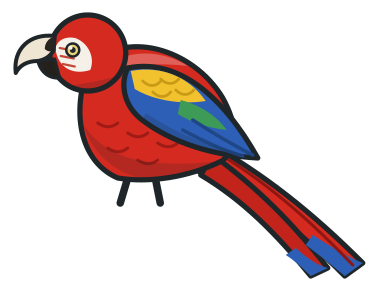
At a glance
| Scientific name | Ara macao |
|---|---|
| Family | New World parrots (Psittacidae) |
| Length | About 80 to 90 cm, of which half or more is tail |
| Range | Southern Mexico and Central America south to the Amazon basin |
| Habitat | Humid lowland forest, especially along rivers; forest edges and tall trees in open country |
| Voice | Loud, harsh, far-carrying squawks and screeches |
| Status | Least Concern worldwide, though gone from much of its former range in Central America; listed on CITES Appendix I |
| In Flocklet | Rarity · 120 points |
How to know it
A very large parrot with a very long, pointed tail. Most of the bird is a vivid scarlet. On the folded wing the upper feathers are bright yellow, often tipped with green, and below them the flight feathers are a deep blue. The lower back is pale blue, and the long red tail ends in blue.
The head is big and the face striking: a patch of almost bare white skin surrounds a pale yellow eye. The bill is enormous and hooked, the upper half pale like old ivory and the lower half black. It cracks hard-shelled nuts with ease, and the bird also uses it like a third foot when climbing.
The scarlet macaw is easily confused with the red-and-green macaw, which has green rather than yellow on the wing and fine lines of red feathers across its white face. The yellow wing band is the thing to look for. Males and females look alike.
Where it lives
Scarlet macaws live in the warm lowlands of the American tropics, from southern Mexico through Central America and south across the Amazon basin. They prefer tall, humid forest, especially near rivers, where big old trees provide food and nest holes, but they also cross open country to reach fruiting trees.
In South America the species is still widespread. In Central America it has disappeared from large areas where the forest has been cleared or where the birds were taken for the pet trade, and it survives there mainly in protected places and in areas where it has been reintroduced.
Habits
Macaws eat fruit, nuts, seeds and flowers, often picking them before they ripen and cracking hard shells that other birds can’t open. Some of what they eat contains bitter or mildly toxic compounds.
In parts of the Amazon, especially in Peru, scarlet macaws gather in the early morning at clay licks: bare riverbanks where dozens of parrots of several kinds cling to the clay and eat it. Why they do it is still debated. The clay may help to neutralise toxins in their food, or supply salt, which is scarce in rainforest diets, or both. The sight of a riverbank covered in red, blue and green birds is one of the great spectacles of South American wildlife.
Scarlet macaws usually travel in pairs or family groups, and pairs stay together for years, often for life. In flight a pair keeps so close that their wingtips almost touch. They nest in holes high in large trees, often old or dead ones, and raise only a few young at a time. They are long-lived birds, capable of living for several decades.
Voice
Loud. The scarlet macaw’s call is a harsh, grating squawk or scream that can be heard across a river valley, and a pair in flight will call back and forth almost constantly, as if checking the other is still there. Perched birds also make softer growls, chuckles and clicks.
People and the bird
Macaw feathers have been prized in the Americas for centuries, and their bright plumes were traded far beyond the forests where the birds lived. The scarlet macaw is the national bird of Honduras and appears in ancient Maya art and carving.
Its beauty has also been its biggest problem. Capture for the pet trade, together with forest clearance, emptied large parts of its range. International trade in wild-caught scarlet macaws is now tightly restricted under CITES Appendix I, and conservation projects in several countries protect nests, build nest boxes and return birds to the wild. Across its whole range the species is still listed as Least Concern, but in many places where it once flew it is now a rare sight indeed.
In Flocklet
The scarlet macaw lands for a Rarity, worth 120 points. In birding, a rarity is a bird that is seldom recorded where you are: the kind that gets reported, that people drive for hours to see, that turns an ordinary morning into a story. A macaw in your garden would do it.
A rarity in the game is an answer that takes real knowledge of the subject. You don’t stumble on it; you get there because you know the field. Asked for a breed of dog, Weimaraner is the sort of answer that gets the macaw. When one lands, you’ll see it: the biggest, brightest bird on the wire so far.