Peacock
Plate IV · Vagrant · 200 points
A bird that seems to have been designed by committee, every member of which wanted more: more blue, more green, more eyes, more tail.
At a glance
| Scientific name | Pavo cristatus |
|---|---|
| Family | Pheasants and partridges (Phasianidae) |
| Length | Male about 2 metres or more including the train; female about 1 metre |
| Range | Native to the Indian subcontinent; kept and gone wild in many countries |
| Habitat | Open forest, scrub and farmland, often near villages, temples and water |
| Voice | A loud, wailing, far-carrying call, often at dusk |
| Status | Least Concern |
| In Flocklet | Vagrant · 200 points |
How to know it
Strictly speaking, “peacock” is only the male. The species is the Indian peafowl; the female is a peahen, and the young are peachicks. Nobody minds much, and in the game we call the bird by its everyday name.
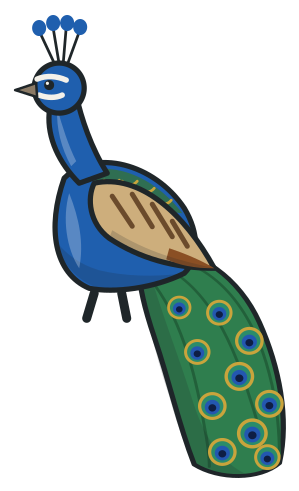
The male’s head, neck and breast are a deep, glossy blue. On the crown stands a little fan of bare shafts, each tipped with a small blue spoon of feather, and the face is marked with bare white skin above and below the eye. The back is scaled in bronze and green, the wings are barred in buff and black, and the flight feathers are chestnut, which shows when the bird flies up to a roost.
Then there is the train. It is not, in fact, the tail. The train is made of around two hundred very long upper tail coverts, the feathers that normally just cover the base of a bird’s tail, each one ending in an iridescent eye. The real tail is short, plain and brownish, and sits underneath, where it helps to prop the train up in display. The male grows a new train each year and sheds it after the breeding season.
The peahen is a quieter bird, mostly mottled brown and grey with a white belly, a metallic green neck and her own small crest. She has no train.
Where it lives
Peafowl are native to the Indian subcontinent, from Pakistan and Nepal through India to Sri Lanka. There they live in open forest, scrubland and farmland, usually close to water, and in many places close to people, where they are protected by custom and law and often quite tame.
People have carried peafowl around the world for thousands of years. They strut across the lawns of palaces, parks and country houses on every continent except Antarctica, and in a number of places they have gone wild and live on their own.
Habits
Peafowl spend the day on the ground, walking and pecking at seeds, grain, shoots, insects and small animals, including small lizards and snakes. At dusk they fly up, heavily but surprisingly well, to roost high in tall trees, where they are safe from predators.
The display is the famous part. In the breeding season the male raises his train into a great shimmering fan behind him, spreads his wings, and turns to face a watching peahen. Then he shivers the train, rattling the feathers so fast that the eyes seem to quiver and a soft rustling sound carries across the ground. Now and then he turns his back on her and swings round again. Peahens judge the show carefully, and it has fascinated scientists since Darwin, who used the peacock’s train to think about why animals evolve such extravagant ornaments.
Voice
For such a beautiful bird, the peacock has a startling voice: a loud, wailing, two-part cry that can sound like someone calling for help. It carries a long way and is heard most often at dusk and in the breeding season. In India the call is traditionally linked with the coming of the monsoon rains.
People and the bird
Few birds have gathered as many stories. The peacock is the national bird of India, where it has long been sacred. In Hindu tradition it is the mount of the war god Kartikeya, and Krishna is shown with a peacock feather in his hair. In Greek myth, the hundred eyes of the watchman Argus were set in the peacock’s tail by the goddess Hera after his death. Early Christians, believing peacock flesh did not decay, made the bird a symbol of eternal life, and it appears in mosaics and carvings from that time onward.
Rulers have always wanted peafowl about them. They walked the gardens of ancient kings, were served at grand medieval feasts, and gave their name to the Peacock Throne of the Mughal emperors. Today the Indian peafowl is common in its native range and is listed as Least Concern.
In Flocklet
The peacock lands for a Vagrant, the rarest kind of answer, worth 200 points. In birding a vagrant is a bird found far outside its normal range: blown off course by a storm, lost on migration, turning up somewhere it has no business being. Vagrants are what keen birders dream about.
A peafowl from the forests of India, sitting on a telegraph wire in an English lane or an American suburb, is about as far as a bird can stray. That’s the answer almost nobody gives: the deep cut, the one that makes other players say “that counts?” It does, and when it lands, the peacock raises its train and shows it off.