Blue Jay
Plate II · Uncommon · 60 points
A loud, crested, startlingly blue bird that arrives at a feeder like it owns the place, and on a grey morning it very nearly does.
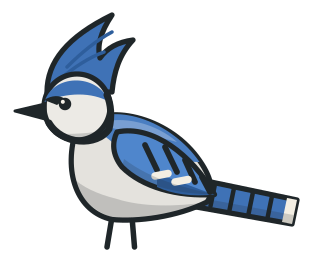
At a glance
| Scientific name | Cyanocitta cristata |
|---|---|
| Family | Crows and jays (Corvidae) |
| Length | About 25 to 30 cm |
| Range | Eastern and central North America, from southern Canada to the Gulf of Mexico |
| Habitat | Oak and mixed woods, woodland edges, parks, suburbs and gardens |
| Voice | A loud, harsh “jay!”, liquid whistles, and good impressions of hawks |
| Status | Least Concern |
| In Flocklet | Uncommon · 60 points |
How to know it
Bigger than a thrush, smaller than a crow, with a long tail and a tall crest that rises when the bird is excited and lies flat when it is calm. Seen well, it is hard to mistake for anything else.
The upperparts are a bright, clean blue. The face and underparts are white or greyish white, and a black necklace runs across the throat and up behind the cheeks, as if the bird had been outlined with a pen. The wings and tail are crossed with fine black bars, and there are bold white patches on the wing and white corners to the tail, which flash when it flies. Males and females look alike.
There is a small surprise in that blue. A blue jay’s feathers contain no blue pigment. The colour comes from the way tiny structures inside each feather scatter light. Hold a fallen jay feather with the light behind it, or crush one, and the blue disappears into a dull brownish grey.
Where it lives
The blue jay belongs to eastern and central North America, from the forests of southern Canada down to Florida and Texas. It has been spreading west in places, helped along by towns, shelterbelts and garden trees.
It likes oaks above all, along with beech and mixed woodland, but it has taken happily to parks and leafy suburbs. Many jays stay put all year. Others move south for the winter, and in autumn loose flocks can be seen travelling along lake shores and ridges, which is a little odd to see in a bird people usually meet one or two at a time.
Habits
Blue jays eat a bit of everything: acorns, beechnuts and other seeds, fruit, insects such as beetles and caterpillars, and now and then an egg or a nestling. At a feeder they are bold and noisy, and other birds tend to give way to them.
Their best-known habit is caching. In autumn a jay will carry acorns away several at a time, held in its throat and bill, and bury them one by one in the ground or tuck them into crevices to eat later. Not every acorn is recovered, and the forgotten ones can sprout. Jays are often credited with helping oak woods spread across the continent after the last Ice Age, simply by planting more than they needed.
Like their relatives the crows, jays are clever and watchful. They gang up to mob owls and hawks, shouting at them until they move on, and they keep an eye on what other birds and animals are doing. Pairs build a cup of twigs in a tree, and both parents raise the young.
Voice
The classic call is a loud, scolding “jay! jay!” that carries a long way through the woods and gives the bird its name. But the blue jay has a much larger repertoire than that: soft, bell-like whistles, a creaking call often compared to a rusty pump handle, quiet chatter between mates, and a remarkably good imitation of the scream of a red-shouldered hawk. Why they copy hawks is not fully understood; it may warn other jays, or simply clear a feeder of competition.
People and the bird
In the east of North America the blue jay is one of the most familiar birds of all, and opinions on it are strong. Some people love its colour and boldness; others think it a bully at the bird table. It has given its name to a Major League Baseball team in Toronto, and its call is one of the sounds of an eastern North American autumn.
The species is widespread and is listed as Least Concern. Like many forest birds it depends on healthy woods, and the oak trees it helps to plant are part of that story.
In Flocklet
The blue jay lands for an Uncommon answer, worth 60 points. Birders use “uncommon” for a bird that is there but not guaranteed: you will probably see one if you look properly, but you can’t count on it. For most of the world the blue jay is exactly that. It is famous, but most people have never seen one, and the ones who have rarely forget it.
An uncommon answer works the same way. It’s the one most people would recognise straight away if you said it, but wouldn’t think of first. Asked for a breed of dog, few people lead with Whippet; tell them, and they nod. That moment of “oh, of course” is what the jay is for.