Birds on a Wire
Plate V · The flock already on the wire
Four small grey shapes on a line against the sky, evenly spaced, facing the same way, waiting: one of the most ordinary sights there is, and the start of every round.
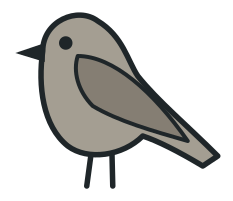
The grey birds in Flocklet aren’t one species. They stand for any small bird you might see on a wire on an ordinary day, drawn plainly so that the words they carry are what you notice. This page is about them, and about why so many real birds choose to sit on wires at all.
Why birds like wires
To a bird, an overhead wire is a very good perch. It is high, so a bird sitting there can see a long way: food on the ground, other birds, and above all anything that might want to eat it. It is open, with nothing nearby for a cat or a hawk to creep up behind. It gives a clear drop for a fast take-off. On a cold morning, a wire in the sun is a warm place to sit and fluff up. And in open country, where trees are few, wires and poles may be the only perches for miles.
Wires also make good meeting places. Birds that feed in the air, such as swallows and martins, use them as resting points between hunting flights, and birds of many kinds gather on them simply because other birds are already there. A bird sitting safely on a wire is a sign to the others that the coast is clear.
Why they don’t get a shock
It looks dangerous, but a small bird on a single power line is perfectly safe. Electricity only flows through something if it offers a path between two points at different voltages. A bird with both feet on the same wire is at the same voltage all over, so no current runs through it.
The danger comes when a bird touches two wires at once, or a wire and a pole or other grounded part at the same time. Small birds rarely manage that, but big ones can: eagles, storks, owls and other large birds with wide wingspans are killed this way in some places. Many power companies now space wires further apart, cover exposed parts or fit perches on poles to make them safer.
Keeping their distance
Watch a row of birds on a wire and you will often see them spaced almost evenly, like beads. Each bird keeps a little personal space around itself, roughly the distance at which a neighbour could reach over and peck it. When a newcomer lands, the others shuffle along to make room, and the spacing settles again. In Flocklet, when a big bird such as the peacock arrives, the grey birds do exactly that.
Who you’re likely to see
Swallows and martins are the classic wire birds. In late summer, before they leave on migration, they gather on wires in long, chattering lines that can stretch from pole to pole, a sight many people take as a sign that autumn is coming.
Starlings line up on wires and roofs in the evening before going to roost. In winter, large numbers sometimes swirl above their roosts in great shape-shifting clouds called murmurations before dropping into reeds or trees for the night.
Pigeons and doves sit on wires above streets and railway lines, and the mourning dove of North America is one of the most familiar wire birds there. Sparrows, finches, blackbirds, kingbirds and shrikes all use wires too, the shrikes and kingbirds as lookouts for insects and other prey.
In Flocklet
Every round begins the same way: four grey birds settle on the wire, each holding a word on a little tag. Together the words share a link, and your job is to name a fifth. The flock is deliberately plain. It is there to be read, not admired.
There is always room for one more. When you find a fifth word that fits, a new bird flies in to take the gap: a sparrow, a jay, a macaw or, if your answer is rare enough, a peacock. The grey birds make room, the wire dips under the new weight, and the flock is complete.