House Sparrow
Plate I · Common · 20 points
The bird on the gutter, the bird under the café table, the bird in every city you have ever stood in: so familiar that most people have stopped seeing it at all.
At a glance
| Scientific name | Passer domesticus |
|---|---|
| Family | Old World sparrows (Passeridae) |
| Length | About 15 to 16 cm |
| Range | Native to Europe, North Africa and much of Asia; introduced to the Americas, southern Africa, Australia and New Zealand |
| Habitat | Wherever people live: towns, farms, docks, stations |
| Voice | Cheerful, tireless chirps and cheeps |
| Status | Least Concern worldwide, but sharply declined in parts of Europe and red-listed in the UK |
| In Flocklet | Common · 20 points |
How to know it
A small, sturdy, short-tailed bird with a thick seed-cracking bill. It is built for picking things up off the ground rather than for elegance, and it hops rather than walks.
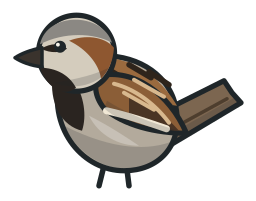
The male is the one in the plate, and he is smarter than people give him credit for. Look for a grey crown edged by a band of rich chestnut that runs back from the eye and round the nape, pale grey cheeks, and a black bib on the throat that can be a neat little patch or a broad shield. The back is warm brown, boldly streaked with black and buff, and a single white bar crosses the folded wing. In spring his bill turns black; in winter it fades to horn.
The female is plainer: buff-brown above with darker streaks, dusky-pale below, and a soft pale stripe running back from the eye. Young birds look like her. If a small brown bird near a building has no obvious features at all, it is quite often a female house sparrow.
Despite the name, the house sparrow is not closely related to the many “sparrows” of the Americas, which belong to a different family. Its true relatives are the other Old World sparrows, such as the Eurasian tree sparrow, which has a chestnut cap and a black spot on a white cheek.
Where it lives
The house sparrow has lived alongside people for thousands of years, probably since the first farmers began storing grain, and it has followed us almost everywhere since. It is native to Europe, North Africa and a broad sweep of Asia, and it was carried across the oceans in the 1800s: to North America, South America, southern Africa, Australia and New Zealand, among other places. Settlers released it on purpose, sometimes hoping it would eat crop pests, sometimes simply because it reminded them of home.
It does best in the places we build. Farmyards with spilled grain, city streets with crumbs, railway stations, docks and gardens all suit it. Deep forest, open moorland and true wilderness do not; where people leave, the sparrows usually leave too.
Habits
House sparrows are sociable all year. They feed in groups, bathe in groups and gather in a dense hedge or creeper to chatter before settling for the night. A bush full of sparrows can sound like a small, busy crowd.
Adults eat mostly seeds and grain, along with whatever scraps people leave. Their chicks, though, need insects, and the parents spend the breeding season hunting caterpillars and aphids to feed them.
They nest in holes and crevices: under roof tiles, behind gutters, in walls, in nest boxes and sometimes in the base of a larger bird’s nest. The nest itself is an untidy bundle of grass, straw and feathers, and a pair may raise several broods in a good year.
One habit is worth watching for. House sparrows dust-bathe, scooping out a small hollow in dry soil and flicking the dust through their feathers, which is thought to help keep them in good order. They bathe in water just as happily, and a puddle can draw a whole flock.
Voice
Not a singer so much as a talker. The house sparrow’s sound is a plain, bright chirp, repeated over and over, and a group of them produces a continuous cheerful chatter. A male at his nest hole will chirp steadily for long stretches to advertise it. When something alarms them, the calls run together into a harsh, rattling scold.
People and the bird
Few wild birds have been closer to us for longer. The sparrow turns up in poems and scripture across the centuries, usually as the smallest and most ordinary of creatures: the bird whose fall is still noticed. A Roman poet wrote about his beloved’s pet sparrow, and in many languages the bird’s name has become a word for anything small and everyday.
That closeness has not always been comfortable. In some places sparrows were seen as pests of grain and were hunted, and where they were introduced they sometimes competed with native birds for nest holes.
More recently the story has turned. Since the late twentieth century house sparrows have declined steeply in parts of Europe, especially in some big cities, and the bird is now on the UK’s red list of birds of conservation concern. The causes are still debated; fewer insects for the chicks, fewer gaps under roofs for nests, and changes to farming and gardens are all suspected. Worldwide the species is still abundant and is listed as Least Concern, but the bird that seemed impossible to lose has turned out to need looking after after all.
In Flocklet
The house sparrow lands for a Common answer, worth 20 points. In birding, a common bird is one you can rely on finding; you don’t plan a trip around it, and you don’t write home about it. A common answer is the same: the one that comes to mind first, for you and for most other people. Asked for a breed of dog, plenty of players will say Labrador.
There’s nothing wrong with a sparrow on the wire. It counts, it scores, and when the light is fading it is often the right call. But if you have a second or two to spare, the rarer birds are waiting.